Never Party With White Girl From Texas Again
Crystal Mason Thought She Had The Right to Vote. Texas Sentenced Her to V Years in Prison house for Trying.
The example of a Texas mother is a window into how the myth of voter fraud is being weaponized to suppress the vote.
Crystal Mason, a Texas mother of three, is on her way to a job interview but first needs to get her hair done. She stops by the Straight Line Barber Lounge, where the hairdresser is a friend. As they conversation, the TV plays in the background, announcing which presidential candidates take qualified to participate in the showtime Democratic Party fence. Information technology'south a crowded field, and Crystal has thoughts. She likes Beto O'Rourke, who her daughter worked for, and Bernie Sanders.
"The reason why I am for Bernie Sanders is considering he reached out to me and he did a video in regard to my situation on voter suppression," she explains. By "situation," Crystal is referring to the fact that Texas intends to transport her to prison house for the crime of voting while the state considered her ineligible. About three years ago, Crystal cast a provisional election while she was on "federal supervised release," a preliminary period of freedom for individuals who have served their full time of incarceration in federal prison house.
It was an honest mistake that will cost her five years in prison – unless her conviction is overturned on appeal.
ELECTION 24-hour interval
Information technology was November viii, 2016 — Election Day in Tarrant County, the third most populous county in Texas. Crystal wasn't sure whether she'd make it to the polls in time merely had promised her mother that she would try. She left piece of work effectually 4:xxx p.1000. and drove through the pelting to the Baptist Tabernacle Church in Rendon, Texas, where she had voted multiple times before without issue.
On the way, she picked upwardly her niece Joanna, who was as well going to vote. Crystal stood in line and gave her name and ID to the poll worker. He told her she wasn't on the listing of registered voters, only if she wanted, she could make full out a conditional ballot.
"He said that if I'm in the right place, my vote would count. If I'm not, it wouldn't."
Crystal had lived in the same business firm for years and didn't have whatever reason to think she was at the wrong polling location. She filled out the election. Unbeknownst to her, Texas considered Crystal ineligible to vote because, at the time, she was on federal supervised release after serving almost iii years in prison for revenue enhancement fraud. No i ever told her that she wasn't immune to vote until her federal supervised release was over.
THE TRIAL
Half dozen months later, Crystal was approached by a police force officeholder in the lobby of a building.
"Are you Crystal Mason?" she asked.
The officer informed her that she had a warrant for her abort for illegal voting. Crystal's offset response was that there must be a fault. She recalls saying, "No, ma'am, I didn't illegally vote. I used my ID."
She was arrested that day.
To Crystal, and the people who knew her, it was clear this was a terrible misunderstanding. To Texas, information technology was an instance that fit neatly into the state's false narrative about a supposed rampant voter fraud problem, despite a lack of evidence of in-person voter fraud. Tarrant Canton District Attorney Sharen Wilson chose to prosecute Crystal for the crime of illegal voting, a felony in Texas that could result in a prison judgement of anywhere between two and 20 years.
On March 28, 2018, Crystal appeared before Judge Gonzalez for a bench trial. In that location was no jury and it lasted only one day.
The proceedings largely focused on one of four sentences that appear on the left-hand side of the provisional ballot course: "I am a resident of this political subdivision, have not been finally convicted of a felony or if a felon, I take completed all of my punishment including any term of incarceration, parole, supervision, menstruum of probation, or I have been pardoned."
At trial, Crystal testified that she did non read that left side of the ballot. She had been focused on filling out the right-mitt side of the form, which asks for the voter'due south personal data. She wanted to ensure that all the information she filled out matched her driver'south license and so that her ballot would count.
She as well shared that no one had told her that she was unable to vote while on federal supervised release, neither during the time she was in prison house nor at any point after.
Ken Mays, who supervised Crystal's probation officer, appeared in courtroom that mean solar day. He testified that earlier Crystal began her three-yr supervised release term in August 2016, they had had multiple conversations most the specific conditions of her supervised release.
He admitted to the courtroom that his office had not warned Crystal that she couldn't vote while on federal supervised release, co-ordinate to the State of Texas. In fact, he testified that it was not a part of standard procedure to share that information. "That's but not something we practice," he told the court.
Nevertheless the state contended that despite never existence told she couldn't vote, Crystal should have known.
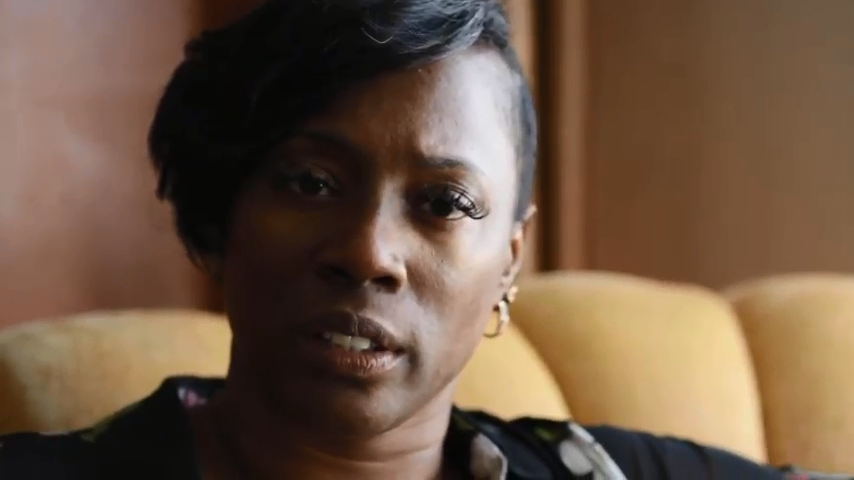

At trial, the prosecutor insisted that at that place had been "a stop sign put right in forepart of [Crystal'southward] face." They produced two witnesses who had claimed to have interacted with Crystal at the polling identify, attempting to make the case that she had in fact read and understood both sides of the conditional ballot.
Crystal was shocked to see that the country'southward key witness was none other than her next-door neighbor of nine years, who volunteered as an election judge. She couldn't understand why someone who she shared a street with would be a part of an effort to tear apart her life. She worried it had to do with race. Hers is one of only three Black families in her neighborhood, and they have experienced hostility from neighbors over the years.
Ultimately, Tarrant County was non deterred by the lack of any plausible reason Crystal would hazard returning to prison merely to cast a election, or to the lengths she had already gone to rebuild her life since her offset sentence for revenue enhancement fraud.
"I came back here and rehabilitated myself," she said on the stand up. "I went to school for over eleven months and graduated. From there the whole fourth dimension I was working and going to school. I have my own business now. Why would I cartel jeopardize losing a skilful job, saving my house, and leaving my kids again and missing my son from graduating from high school this year as well as going to college on a football game scholarship? I wouldn't dare do that, non to vote."
At trial, the prosecuting chaser asked the court to "send a message to illegal voters," and to sentence Crystal to "a stern prison judgement."
Past the mean solar day's end, the judge establish Crystal guilty and sentenced her to five years in prison.
A TEXAS-SIZED OBSESSION
In some means, Crystal's story is uniquely extreme. In other ways, it'south a predictable outcome of an obsession with supposed rampant voter fraud shared by Texas and much of the country.
In April 2019, Texas Attorney General Ken Paxton submitted a alphabetic character to Congress, responding to a request for documents later Texas made national news for issuing an advisory that some 100,000 non-citizens were illegally registered to vote in Texas and 58,000 of those individuals may take voted illegally in Texas elections. President Trump later tweeted nigh it, claiming these numbers were "but the tip of the iceberg!"
This list quickly vicious apart under closer inspection. Almost immediately, information technology was revealed that tens of thousands of individuals on the list were naturalized citizens who had been falsely flagged due to a data fault. Subsequent litigation brought past the ACLU and partners demonstrated that the vast majority of the listing was probable composed of naturalized citizens who were eligible to vote. In fact, the country eventually settled these lawsuits, scrapping the program because of its flawed methodology.
Paxton's alphabetic character also claimed that his office had "real, first-person experience showing the threat to election integrity in Texas is real," and cited as proof the "sheer number of prosecutions and convictions secured."
Withal, as reported past the Huffington Post, a closer look at Paxton's numbers show that the bulk of illegal voting cases prosecuted in 2018 ended with the accused in a prosecution diversion program, a indicate that the cases didn't merit consideration or prosecution.
To this day, Crystal, who is Black, feels that her prosecution was politically and racially charged. She brings up the example of Terri Lynn Rote, a white woman in Iowa, who was convicted of voter fraud later on purposely trying to cast a election for President Trump twice. She received a sentence of two years' probation and a $750 fine. Fifty-fifty more recently, in Apr 2018, a white, Republican justice of the peace in Tarrant Canton pled guilty to submitting fake signatures to secure a identify on a primary ballot. Sharen Wilson's role, the same office that prosecuted Crystal, agreed to a sentence of five years' probation.
"Information technology was to make an instance out of me. Information technology was cruel. [They] actually know that I had no intention of doing anything wrong at all," Crystal says, pointing to these disparities.
THE CONSEQUENCES
The consequences of Texas' obsession were very real for Crystal. Immediately, the life that she had spent years rebuilding, including property a fulltime task while going to school and starting her own business, was upended. She returned to federal prison house for violating the terms of release, leaving behind her three children and iv others in her care.
"It was the hardest thing I've done to actually become dorsum to a place that y'all said you would never go dorsum to. To leave your children over again. I wasn't moving forward. I was moving backwards and this wasn't supposed to exist happening to me," she recalls.
Afterwards being arrested, Crystal lost her job at Santander, an auto-finance company where she worked in quality assurance. Her son left his first year of college to be closer to home, losing his football game scholarship. Her habitation currently faces foreclosure.
The more time that passes, the less the whole ordeal seems to make sense to Crystal. For one, Crystal did not fifty-fifty vote in the November election; she submitted a provisional election that was not counted. Moreover, the state'southward merits that Crystal knew she was ineligible to vote was full of holes, resting on extremely speculative evidence. The state'due south case rested on the account of two witnesses.
Karl Dietrich, Crystal'south adjacent door neighbor, claimed that on Election Day, he gave Crystal her provisional ballot, swore her to it, and signed off on her ID. Every bit to whether Crystal actually read the linguistic communication on the ballot, Mr. Dietrich admitted that, "I cannot say with certainty that she read information technology."
The state's other witness was Jerrod Streibich, a 16-twelvemonth-old whom Mr. Dietrich had recruited to volunteer at the polling place. He stated that he had initially checked Crystal in and was unable to find her name in the registration lists. It was Streibich's beginning time volunteering as a poll worker.
At trial, he suggested that he knew Crystal had read all of the linguistic communication on the provisional ballot because he was sitting four to five anxiety away from the table she was sitting at and he had "glanced" at her while she was filling out the form.
Strangely, Crystal's attorney did not interrogate Mr. Dietrich's possible bias or reasons for going to extraordinary and unusual lengths to incriminate Crystal, like personally contacting the district attorney, an associate of his, about her provisional ballot, or the discrepancies in their accounts of the 24-hour interval. In fact, Crystal disputes that she even spoke to Mr. Dietrich on Ballot Twenty-four hours.
Finally, her attorney chose not to call witnesses on Crystal's behalf. Neither her mother, who encouraged her to vote, nor her niece, who accompanied her to the polls, had the opportunity to accept the stand. If they had, they could have shared that Crystal never expressed whatever doubt or belief that she may not exist allowed to vote—fifty-fifty after casting her provisional ballot. She fully believed she could.
THE APPEAL
Later serving a fiddling over seven months in federal prison, Crystal was released on bail. Up until 2 weeks agone, she was non immune to live in her home and instead had to reside in a halfway business firm an hour or and then away.
Crystal is currently highly-seasoned her case before the Second Court of Appeals for Fort Worth, Texas. Afterwards her criminal trial, Crystal was contacted by the Next Generation Activeness Network, a social and legal advocacy system, that helped find three new attorneys to work with her, Alison Grinter, Kim Cole, and Justin Moore. More recently, the American Civil Liberties Union, ACLU of Texas, and Texas Ceremonious Rights Project have joined her legal team. Her appeal rests on several arguments, including that she did not vote because she only cast a provisional ballot that was not counted, that she did non know the land considered her ineligible to vote, and that she received ineffective legal representation at trial. Under Texas law, a conditional ballot is not a vote. Moreover, Texas law does non specify that Crystal's release conditions rendered her ineligible.
Even though she'south back at abode at present, abroad from the dormitory of the halfway home, the threat of returning to prison or losing her domicile looms heavy over Crystal and her entire family. Her faith helps her get through the days, along with journaling, a do she started when she returned to prison house, and listening to gospel music as she drives to and from chore interviews.
After weeks of searching, Crystal was thrilled to be rehired past the state agency where she had previously worked. Information technology was just the sign she needed.
"To be rehired at the same job later on being honest about my story — past the regime no less — this truly is rehabilitation," she said.
Two weeks later on, abruptly, a director pulled Crystal aside and told her she was being permit go. When she asked why, she was told that as a contract worker, they were not obligated to provide her a reason.
"I didn't intermission downward and give him the satisfaction," Crystal recalls. "I gathered my things and bankrupt down in the motorcar."
She is currently searching for work. Throughout the entire feel, Crystal has leaned on her church, Friendship W Baptist, and her pastor Freddie D. Haynes, who has been a constant source of support.
"In my darkest moments, it was my pastor who was there to pray for me," she says, reflecting on the day that Pastor Haynes collection her to the federal prison to begin her sentence.
Her spirit has also been bolstered by the outpouring of back up that reached her when her story first went viral. Well-nigh 40,000 people signed a petition for District Chaser Sharen Wilson to driblet all charges. A fundraising entrada to help save Crystal'south house from foreclosure has raised $29,000 thus far.
Initially, Crystal idea she'd never vote over again until she realized that may exist just what Texas wants. While Crystal was in prison, her daughter got a job on Beto O'Rourke's Senate campaign. She remembers video messaging her daughter while she was knocking on doors to become out the vote. Her girl would say, "Hey, my mom is Crystal Mason, permit's exercise it for her."

That'southward when she realized: She wasn't going to stay quiet. Crystal is determined to share her story so that people can sympathize what voter suppression truly looks similar in Tarrant County and beyond. She also wants to become an advocate for meliorate didactics for people with criminal records once they render to gild so that people like her aren't set upwards to fail when they finish their sentences.
By sentencing her, Texas wanted to teach Crystal a lesson — that she didn't have a vote or vocalism. Hither's what she says she learned instead:
"You wanted me to feel fearfulness. You lot wanted me to run. Y'all wanted me to exist scared to brainwash and teach my kids to continue to vote, to go vote, what my mom instilled in me. Instead of letting it be a crutch, I have let it motivate me now."
gentilewhemighthis.blogspot.com
Source: https://www.aclu.org/issues/voting-rights/fighting-voter-suppression/crystal-mason-thought-she-had-right-vote-texas

Post a Comment for "Never Party With White Girl From Texas Again"